
When grayish-white cottony tufts appear on a fish, water mold disease (saprolegniasis) is a common differential. Water mold usually grows on damaged skin or on eggs, so beyond dealing with the growth itself, you need to find the source: injury, parasites, bacterial infection or environmental stress.[1][2]
What to check first when you see white fuzz
Test the water and check aeration, and think back to whether there's been any recent netting, transport, fighting, sudden temperature drop or excessive chemical treatment. Note where the fuzz is, how quickly it's spreading and whether there are also ulcers, and avoid netting the fish repeatedly just to keep checking.
Remove dead fish, leftover food and decaying organic matter, and keep the water temperature and conditions appropriate for the species. If several fish are affected, lesions are spreading quickly, the gills or mouth are involved, or breathing and eating are clearly abnormal, see a veterinarian as soon as possible.
Water mold is actually an oomycete
Water mold disease is often associated with the genus Saprolegnia. It belongs to the oomycetes and is not taxonomically a true fungus; "fungus" in older literature and the everyday name "water mold" are traditional names that have stuck because of its similar appearance.[2]
Other oomycetes also cause fish disease, but not every oomycete infection should be treated as ordinary water mold. For example, Aphanomyces invadans can cause epizootic ulcerative syndrome (EUS), a separate disease that needs professional differentiation; a deep ulcer shouldn't be written off as simple surface water mold just because there's white fuzz on it.[2][3]
Why fuzz often appears after an injury
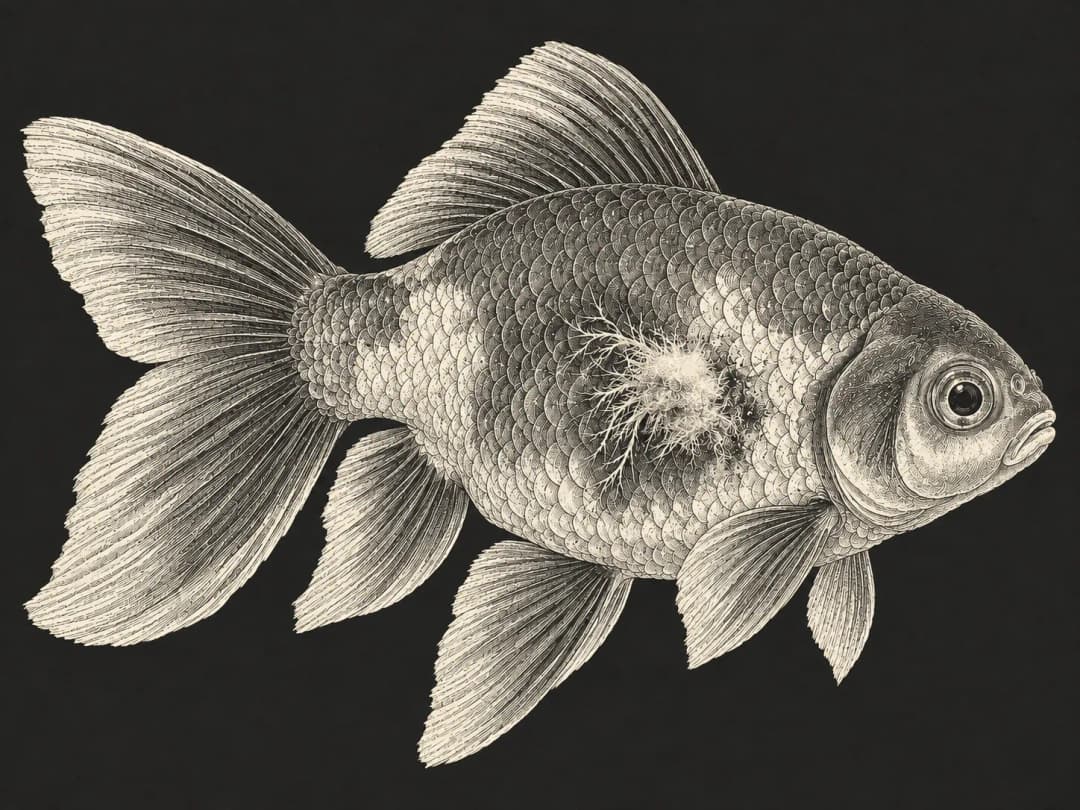
Spores in the water and contact with the environment are very common, and healthy fish usually have defenses in their mucus, skin and immune system. Once injury or another pathogen breaks down that barrier, water mold can more easily colonize the damaged tissue, so it's often a secondary infection.[1][2]
| Possible trigger | Clues owners can check |
|---|---|
| Netting and bumps | Whether the wound appeared after recent handling or fighting. |
| Parasites and bacterial infections | Whether there are also visible parasites, redness and swelling, ulcers or other lesions. |
| Unsuitable water temperature or sharp swings | Compare with the species' needs and with records from before and after water changes, power outages or cold snaps. |
| Crowding and poor hygiene | Whether stocking density is too high, and whether dead fish, leftover food or decaying matter has built up in the tank. |
| Chronic stress and lowered immunity | Whether other sources of stress have been present for a long time, or the fish itself is in poor condition. |
These are risk factors to look for and can't confirm a diagnosis on their own. Some Saprolegnia can act as primary pathogens, so "usually secondary" is more accurate than "always follows an injury."[1][2][4]
White fuzz versus columnaris
Water mold usually looks like grayish-white, cottony, filamentous growth and can appear on the skin, gills, eyes or fins. Color and fluffiness can only offer clues.[2]
Columnaris is a bacterial infection and can also make the mouth or skin look cottony, with erosion, saddle-shaped patches or yellowish-white, mucus-like material. The two can occur together or one after the other; even when water mold is confirmed, don't overlook a bacterial lesion that may lie underneath it.[5]
Microscopy can identify water mold's broad, nonseptate hyphae; culture, histopathology or other tests can follow if needed. Don't scrape or pull off the fuzz yourself, as handling can further damage the skin.
Why fish eggs grow fuzz and how it spreads
Dead and spoiled eggs can serve as a substrate for water mold, and the hyphae then extend to nearby eggs. According to a manual on the artificial propagation of warm-water fish, normally developing eggs are usually transparent with clear contents, while bad eggs are white and opaque with cloudy contents; unfertilized eggs are hard to tell from fertilized ones early on and only fall behind normal development at the first cleavage. Whether an egg is fertilized or dead also needs to be judged according to the species and stage of incubation.[6]
For breeding systems, the warm-water fish propagation manual notes that incubation needs clean, oxygenated flowing water, and that hatched larvae should be separated from the eggshells and bad eggs.[6] Don't disrupt parental care or harm healthy embryos for the sake of cleaning.
If eggs keep growing fuzz over large areas, look beyond the growth itself at fertilization, the condition of the parents, the incubation environment and other infections, rather than just adding more chemical treatment.
Treating water mold means fixing the original problem too
Improve water quality, temperature and hygiene first; if the wound came from parasites or bacteria, the primary problem also needs to be addressed. If the fuzz only recedes temporarily without the source of the wound being resolved, it may keep coming back.[1][2]
Whether to use medication, and which one, is up to the veterinarian based on the species, the lesions, any mixed infections and the system's conditions. Use a legally registered veterinary drug that's appropriate for the case, following the label and your veterinarian's instructions.
Frequently asked questions
If white fuzz appears when the weather turns cold, can I be sure it's water mold?
No. Water below the suitable temperature may increase susceptibility, but other lesions can look similar, so the fish still needs to be examined.[2]
Can fish get water mold without an obvious injury?
It's possible. Skin damage isn't always visible to the naked eye, and there may be an underlying primary disease; some water molds can also act as primary pathogens.[4]
Once the white fuzz is gone, can I stop worrying about the original wound?
You still need to monitor tissue healing, eating and breathing, and confirm that whatever caused the wound has improved.
Further reading
- What to Do When Your Fish Is Sick – Reading Aquarium Fish Symptoms and What to Do First
- Ammonia and Nitrite Poisoning – Fish Gasping at the Surface and How to Read Water Test Kits
- Columnaris Disease Symptoms – Recognizing Rotting Gills and Fins and Cottony Growth on the Mouth
- Parasites Visible on Your Fish – Identifying Anchor Worms and Fish Lice and Understanding Their Life Cycles
References
- Francis-Floyd R, Stilwell NK, Yanong RPE. Introduction to Fish Health Management. UF/IFAS, CIR921/FA004, 1990 (revised 2025).
- Petty BD, Francis-Floyd R, Yanong RPE. Parasitic Diseases of Fish. Merck Veterinary Manual, revised 2022.
- WOAH. Infection with Aphanomyces invadans epizootic ulcerative syndrome. Aquatic Manual, Chapter 2.3.1, 2023.
- Alaska Department of Fish and Game. Saprolegniasis Cotton Wool Disease, accessed October 2026.
- Declercq AM et al. Columnaris disease in fish a review with emphasis on bacterium-host interactions. Veterinary Research 44, 27, 2013. doi:10.1186/1297-9716-44-27.
- Woynarovich E, Horváth L. The Artificial Propagation of Warm-water Finfishes. FAO Fisheries Technical Paper 201, 1980.