
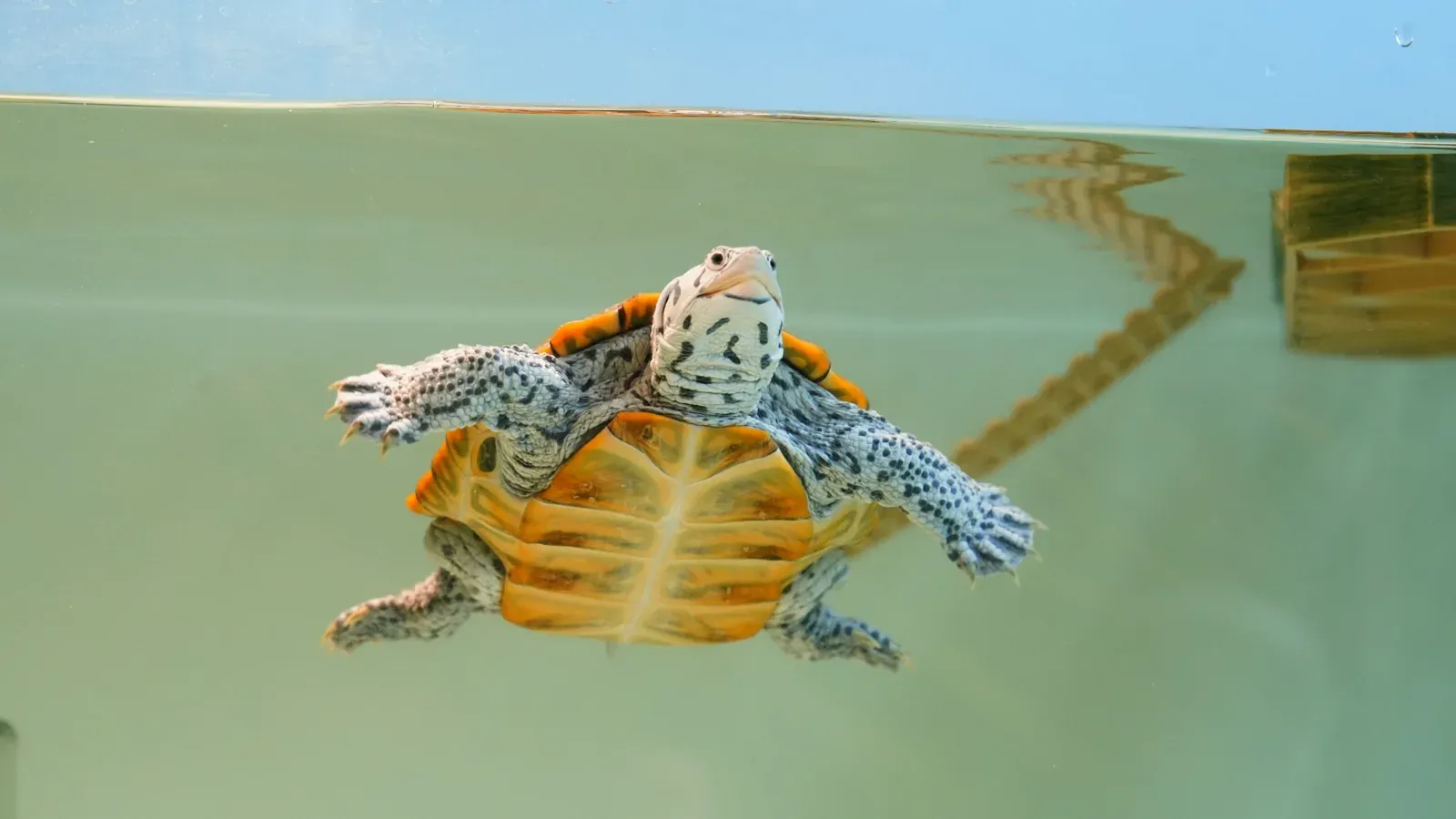
Aquatic turtle care can start with setting up a dry area, a shallow-water area and a deep-water area, followed by suitable temperatures, lighting and a diet whose total amount you can control. These three zones let a turtle rest out of the water, breathe easily and swim, and they form the basis of everyday care. Hatchlings and young turtles in particular need a stable, suitable temperature, so air conditioning switching on and off and nighttime changes should all be managed.
Common aquatic turtles this guide covers
This guide applies to common pet aquatic turtles that are active in the water and climb out to rest, such as the Chinese stripe-necked turtle (Mauremys sinensis), the red-eared slider (Trachemys scripta elegans), the diamondback terrapin (Malaclemys terrapin), Reeves' turtle (Mauremys reevesii) and the painted turtle (Chrysemys picta). They can follow this guide's three-zone setup, stable warmth for young turtles, portion control, cleaning routine and health observation, while water depth, suitable temperatures, adult space and diet are still adjusted to the actual species and individual.[1][2][3][4][5][6]
This guide covers freshwater captive care and does not treat adding salt as a routine step. Diamondback terrapins have also been documented being raised in captivity in fresh water, so they can be included in the shared freshwater care practices; if your turtle was previously kept in other water conditions, first confirm its source and existing care routine before evaluating any change. Tortoises, sea turtles and turtles with different lifestyles should follow guidelines for their own species.[3][6]
Plan equipment around adult needs, while keeping room to turn around, climb out and carry out maintenance. Don't judge a tank by liters alone; once land and water features take up space, the turtle should still have enough usable area. Keep new turtles on their own at first to check feeding, swimming and outward condition before deciding what comes next. Housing turtles together also depends on chasing and biting, differences in size and competition for basking spots; being aquatic turtles doesn't automatically mean they can share a tank.
Setting up the dry, shallow and deep areas
| Area | Setup and use |
|---|---|
| Dry area | Provides a stable, non-slip spot where the turtle can rest and bask fully out of the water; the turtle should be able to climb up on its own and dry off completely once out. Arrange heat and UVB according to actual care needs. |
| Shallow area | Lets the turtle support its body and easily raise its nostrils above the water to breathe; a gentle slope or sturdy shallow platform can link the dry area and the deep area. |
| Deep area | Provides water for swimming, turning and exploring; adjust depth to carapace length, mobility and how well the turtle actually surfaces, and keep an easy-to-reach shallow resting spot. |
Keep the three zones easy to move between, with no gaps that could trap a turtle, and never make a turtle swim for a long time before it can climb out. There is no single area ratio for every turtle; first make sure each one can choose for itself whether to rest or be active, then adjust as it grows. Young turtles especially need easy-to-reach shallow and dry areas, not just a whole tank of deep water.[7][6]
Dried leaves can add underwater cover for young turtles
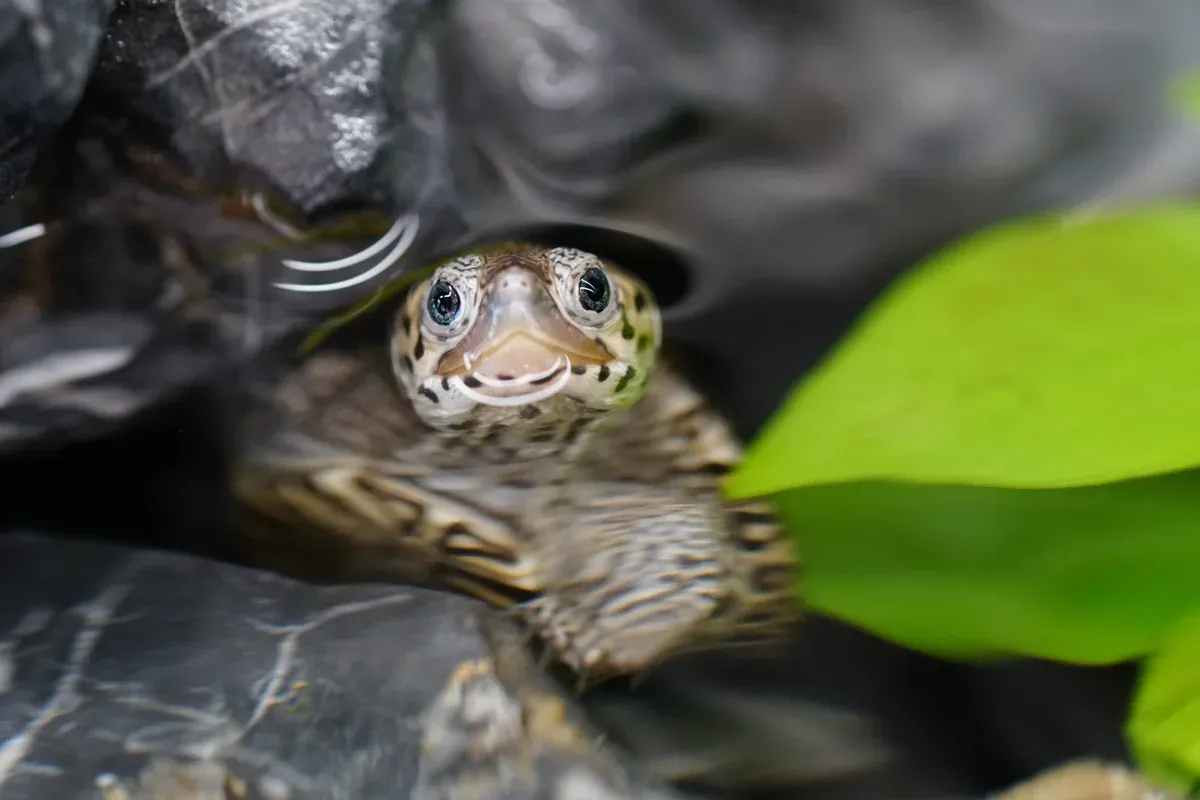
Besides easy-to-reach shallow and dry areas, young turtles also need places to hide and rest. Once you have confirmed the leaf type and its source, you can add a small amount of washed, dried Indian almond leaves (Terminalia catappa) or longan leaves (Dimocarpus longan), placed near the shallow area as underwater cover. The aim is to reduce constant exposure and outside disturbance so the turtle can choose for itself whether to hide or be active. Providing hiding places is grounded in care practice.[8][9][10]
Leaves should come from a known source, be free of pesticides or other chemical treatments, and be dry, without mold spots or odd smells. Rinsing in clean water removes surface dirt but can't be counted on to remove pesticides. Start with a small amount, don't pile it into a thick layer or cover the whole surface, and don't block the turtle's breathing at the surface, its route out of the water or the filter intake and outlet. Check daily and remove leaves that are visibly rotting, smell or have broken into many pieces, and keep up your usual cleaning and water-change routine.
Plan deep-water depth around carapace length and swimming ability
For healthy, strong swimmers that can reliably surface to breathe, the deep area can start at about 2 to 3 times the carapace length, then be adjusted by species and how the turtle actually does. RSPCA Australia's care information for Australian freshwater turtles also lists a water depth of 2 to 3 times; this guide uses it as a reference for planning the swimming area, not as a shared minimum or maximum depth for all aquatic turtles. Turtles that mainly move along the bottom or aren't strong sustained swimmers shouldn't have the depth multiple applied directly.[11]
| Straight carapace length | 2 to 3 times, worked example |
|---|---|
| 5 cm | 10 to 15 cm |
| 10 cm | 20 to 30 cm |
| 20 cm | 40 to 60 cm |
Straight carapace length doesn't include the head or tail; water depth is measured from the substrate surface to the water surface. The table is only an arithmetic example and applies only when the species and its swimming ability fit. Next to the swimming area, provide a stable shallow resting spot or safe foothold where the turtle can support its body and put its nostrils above the water; ramps should be easy to climb, and the haul-out area should be completely out of the water. Leave enough height to prevent escapes, and avoid gaps that could trap a turtle, rock piles that could collapse and filter intakes with strong suction.[7]
Increase water depth for young turtles gradually, watching whether they can surface on their own, get back to a foothold and climb out. Don't fill a tank to the multiple for turtles that are weak, swim unsteadily or have health problems; first give them a safe setup where breathing is easy, and have a reptile veterinarian assess them. The right depth doesn't mean the length and width are enough; recheck both the swimming area and the land area as the turtle grows.
Heat and UVB over the dry area
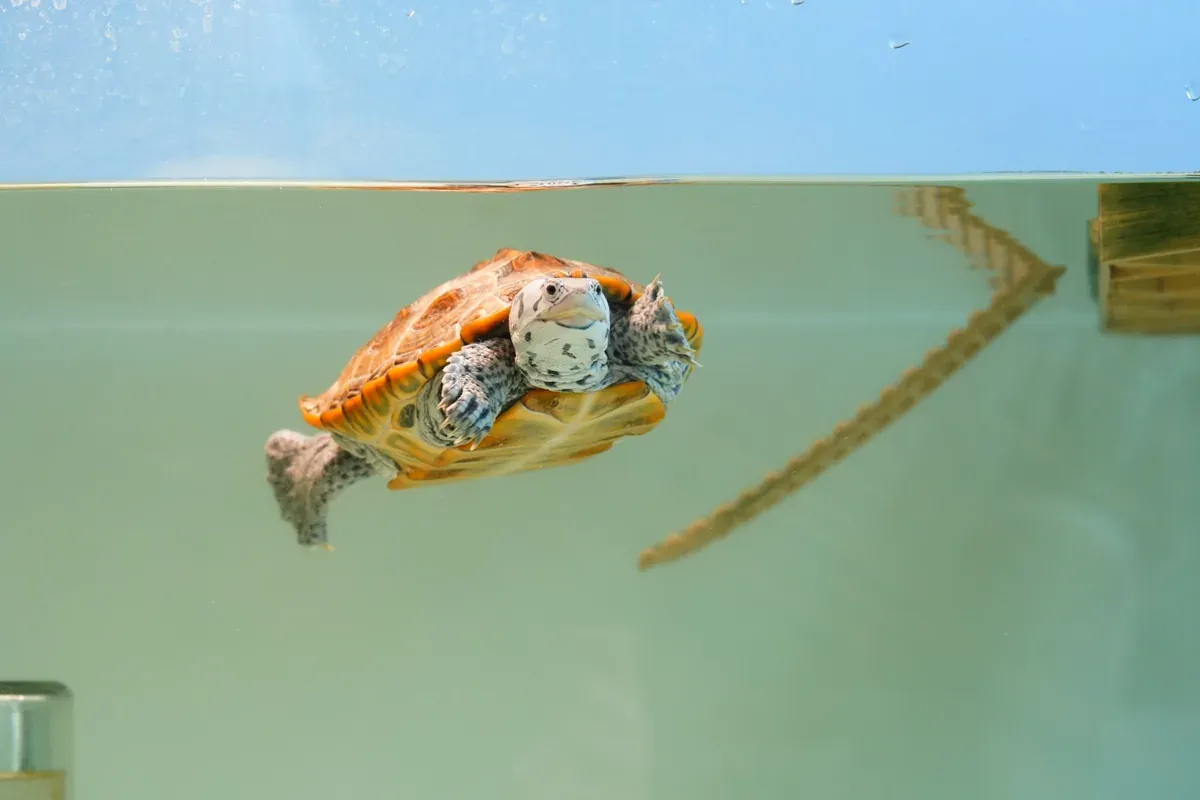
For species that need to bask out of the water, provide a stable, non-slip platform where the turtle can dry off completely. Place the heat source where the turtle can't touch it directly, and leave a cooler area it can retreat to. UVB serves a different purpose from ordinary lighting; set up equipment according to its output, distance, mesh cover and the manufacturer's replacement instructions. Sunlight through glass can't be considered a reliable source of UVB. Keep a regular day-night cycle, and don't keep heating with a light at night.[6]
General guidelines don't set one water and basking temperature for every aquatic turtle. For example, VCA's red-eared slider care page lists a water temperature of 24 to 29°C; that is only an example from one guideline and can't be turned into the optimal range for every species and setup. Look up the needs of your species, age and health first, then measure the water, the basking spot and the cooler area.[7]
Monitor warmth for young turtles and indoor air-conditioning changes all year round
Keeping young turtles warm can't wait until winter or until they stop eating. Reptiles are ectotherms, and temperature affects their bodily functions; aquatic turtle guidelines also include suitable water temperature, heat sources and measurement as part of everyday care. Keeping temperature steady means maintaining stable conditions suited to the species while preserving a temperature gradient, not making the whole enclosure equally warm all day.[6][12]
Heat the water with a heater suited to the water volume, with thermostatic control and burn protection, and check the actual water temperature with a separate thermometer.
For a young turtle's tank, a securely fitted, ventilated lid is recommended to keep air flowing well, avoiding a sealed setup where stuffiness and moisture build up. Combined with keeping it out of direct air-conditioning drafts, managing room temperature and thermostatic equipment, this helps maintain suitable temperatures when the air conditioning turns on and off.[19][6]
Keep the tank out of the direct draft of air-conditioning vents, and measure the water, basking spot and cooler area separately.
After the air conditioning turns on or off, settings change or lights go out at night, track the highest and lowest temperatures to confirm the equipment still maintains suitable conditions.
Keep nights dark; if measurements show it is too cold, adjust the room temperature or consider a thermostatically controlled heat source that doesn't emit light, while avoiding burns and keeping air flowing.
When the air conditioning is off or the room warms up in summer, also guard against overheating and make sure the cooler area is still available for retreat.
These are practical arrangements for monitoring the environment. A heater being on doesn't mean the haul-out area is warm enough, and the room temperature shown on a remote control can't replace measuring inside the tank. Pay particular attention with young turtles, sick turtles and indoor spaces with unstable temperatures; don't skip measuring because of a turtle's native range or a reputation for being "hardy." Refusing food in the cold also shouldn't simply be treated as normal hibernation; dormancy should be managed according to the species and a veterinarian's assessment.
Diet: know what the species eats, then control portions by life stage
Set the balance of plant and animal foods according to species first, then adjust for growth and body condition. You can't apply the diet ratio for Chinese stripe-necked turtles or red-eared sliders to all aquatic turtles, and meat, dried shrimp or any single food shouldn't be treated as a complete diet. Choose safe foods from known sources, make sure plants are edible and clean, and base any calcium or vitamin supplements on the overall diet and professional advice.[13][6]
| Stage | Feeding frequency and portion management |
|---|---|
| Healthy young turtles | Offer small portions sized for their mouths every day, adjusting by species, swallowing and growth; don't apply the adult total directly. |
| Subadults | Adjust gradually according to growth, activity and body condition, recording the amount of each food type and any leftovers. |
| Healthy, active adults | This guide uses one small meal a day as a practical approach; count all staples and supplementary foods toward the total and adjust by species and body condition. |
For adults fed one meal a day, the key is dividing up the total. Some general veterinary guidelines feed adult turtles every other day or every few days; this guide's small daily meal is not a frequency proven to be the single best for every species. If you previously fed every other day or a few meals a week, switching to daily feeding means making each meal smaller; don't repeat the old full-meal portion every day. Health problems, dormancy or special nutritional needs should be assessed by a veterinarian.[13][12]
As a starting estimate, each meal of dry food can be about the volume of the turtle's head (not including the neck), meaning the total volume of food for the whole meal. This is a practical way to estimate and should still be adjusted for species, age, the food's energy density, growth and body condition. When adults are fed a small meal daily, scale each meal down from the previous total rather than always feeding a full head's volume every day. Record the amount with a measuring spoon, stop and clean up as soon as eating slows or food is left over, and don't decide to feed more just because the turtle keeps begging. About 3 minutes of feeding observation can help with portion control; regularly record weight, carapace and body condition, then adjust portions. Vegetables, live foods and other supplementary foods are planned separately according to the species' diet and counted toward the overall diet.[20]
Aquatic turtles that need to swallow food in the water can be fed measured portions at a set spot in their own tank, or in a feeding container at the same temperature if they accept it. If moving them causes obvious stress, focus instead on improving how you feed and clean in their own tank. Manage the source and pathogen risk of live foods, and keep dry food dry and use it before its expiry date.[13]
Choose turtle food by mouth size and species
Ultra Fresh's BABY TURTLE, JUVENILE TURTLE and TURTLE deodorizing nutri sticks can be evaluated based on their current package positioning, your turtle's mouth size and the species' needs. The official website positions them by product size for carapace lengths of 3 to 6 cm, 6 to 15 cm and over 15 cm respectively; this is product selection information, not a maturity threshold or a dietary classification for all turtles.[14][15][16]
For species that need plant foods, vegetable ingredients in a food don't mean you can skip suitable plant foods; for turtles with other diets, don't add a fixed vegetable-to-meat ratio on your own because of a product name. Calcium in the food can't replace suitable lighting and heat. The adult formula follows the same total-amount management of one small meal a day, and the word "deodorizing" in the product name is not a promise that water changes can be skipped or that it has any treatment effect.

Do water changes, cleaning and health checks together
In a tank with enough water, a working filter and stable water quality, do a partial water change once a week on a fixed schedule; adjust the amount to water volume, waste, feeding load and test results. Remove leftover food daily, and check the filter, intake guard and platform stability; at each weekly water change, also clean out waste that has built up on the bottom. If ammonia or nitrite tests come back abnormal, change water sooner and find the cause. A filtered tank still needs maintenance, and the absence of a bad smell doesn't prove the water is in good shape. Top up with new water that has been treated for chlorine and chloramine and is close in temperature, and clean mechanical and biological media separately so you don't disrupt the whole treatment system at once.[19]
Record whether the turtle eats, enters the water, climbs out and swims steadily, and check for discharge from the eyes or nose, skin wounds and localized changes in the shell. If it is weak, keeps refusing food, breathes with its mouth open, has bubbles from the nose or mouth or swims lopsided, get temperature and water-quality details and videos to a reptile veterinarian as soon as possible. A single outward sign can't identify a specific illness, and extra calcium or keeping the turtle dry on your own shouldn't replace a diagnosis.[17]
Wash your hands with soap and water after touching turtles, tank water or equipment. Keep cleaning tools separate from food-handling tools, and avoid washing turtle tank items in food preparation areas. Reptiles that look healthy can still carry Salmonella, so everyday hygiene needs to be kept up consistently.[18]
Aquatic turtle care FAQ
Can I add Indian almond leaves or longan leaves as cover for young turtles?
They can be used as a small, optional source of underwater cover, provided you confirm the leaf type and source, there are no pesticides or chemical treatments, and the leaves are washed and free of mold and odd smells. Keep the routes for breathing and climbing out clear, check the leaves and water quality daily, and remove them when they rot or break into many pieces. Their purpose is to provide places to hide and rest.[8][9][10]
Can Chinese stripe-necked turtles, red-eared sliders and diamondback terrapins all follow this guide?
They can follow the shared principles of a three-zone setup, stable warmth for young turtles, portion control, and cleaning and observation. This guide covers freshwater captive care; water depth, suitable temperatures, diet and adult space should still be adjusted to the species and the individual turtle.
Does the water have to be 2 to 3 times the carapace length?
A deep area of 2 to 3 times the carapace length can be used as a planning reference for healthy, strong swimmers. You still need to confirm the species and the turtle's actual swimming ability, pair it with a shallow resting spot where breathing is easy, and watch whether it can surface and climb out on its own.
If a young turtle lives in an air-conditioned room, is a heater enough?
A securely fitted, ventilated lid is recommended, and keep the tank out of direct air-conditioning drafts. Also measure the water, basking spot and cooler area separately, track changes after the air conditioning turns on or off and after lights go out, and adjust with room temperature and thermostatic equipment. Heating the water can't guarantee that conditions out of the water are suitable too.[19][6]
Will feeding adult turtles once a day be too much?
It depends on the total amount. Head volume can be a starting estimate for a portion of dry food; when adults switch to daily feeding, you still need to make each meal smaller than before, count all staples and supplementary foods, and adjust according to weight, body condition and the species' needs.[20]
Should all aquatic turtles eat the same ratio of vegetables to meat?
First confirm what the species eats. The balance of plant and animal foods needs to be adjusted for species, growth and health; no single percentage can be applied to all aquatic turtles.
Related products
References
- Taipei Zoo: Chinese stripe-necked turtle
- The Reptile Database Trachemys scripta
- McCole et al.: captive rearing of hatchling diamondback terrapins in fresh water
- The Reptile Database Mauremys reevesii
- The Reptile Database Chrysemys picta
- Merck Veterinary Manual Management and Husbandry of Reptiles
- VCA Housing Aquatic Turtles
- CROW: hatchling turtle rehabilitation case
- Think Turtle Conservation Initiative: hatchlings and shallow-water cover
- Betta Botanicals: longan leaves for aquarium use
- RSPCA Australia: Australian freshwater turtle care and water depth recommendations
- MedVet Aquatic Turtle Care Recommendations
- VCA Feeding Aquatic Turtles
- Ultra Fresh BABY TURTLE deodorizing nutri stick
- Ultra Fresh JUVENILE TURTLE deodorizing nutri stick
- Ultra Fresh TURTLE deodorizing nutri stick
- Dr. Li Yen-tao (veterinarian): Chinese stripe-necked turtle care notes
- CDC Reptiles and Amphibians
- RSPCA UK aquatic turtle care: ventilated lids, temperature management and weekly water changes
- Animal Hospital of Verona aquatic turtle care: estimating pellet portions by head size