

Good guppy care comes down to stable water with a moderate mineral content, a staple food small enough for their little mouths, and enough space for the population once they start breeding. Looking easy to keep doesn't mean you can skip filtration or use pure water straight. This guide focuses on the common guppy, Poecilia reticulata, with feeding planned separately for adults and fry.
What water conditions do guppies need?
| Item | Reference and practice |
|---|---|
| Water temperature | OATA guidance gives 20 to 28°C; at home you can plan around a stable 24 to 26°C, a practical starting point within that range.[1] |
| pH | About 7.0 to 8.0.[1] |
| General hardness (GH) | About 8 to 18°dH, a reference for moderately hard to hard water.[1] |
| Tank | A small group can start at 45 liters or more; expand the space as numbers grow or after breeding.[1] |
| Filtration and flow | Established filtration with gentle flow; add an intake guard in a fry tank. |
| Feeding adults | Start with one small meal a day; the daily total can be split into 2 meals. |
Plants and swimming space, with fry kept out of the filter
Keep open swimming space along with plant cover, and avoid sharp decor and strong currents for long-finned strains. If your guppies breed, use dense fine-leaved plants or other safe cover to give fry somewhere to hide, and fit the filter intake with a suitable sponge guard, cleaning it regularly so it doesn't clog.[1]
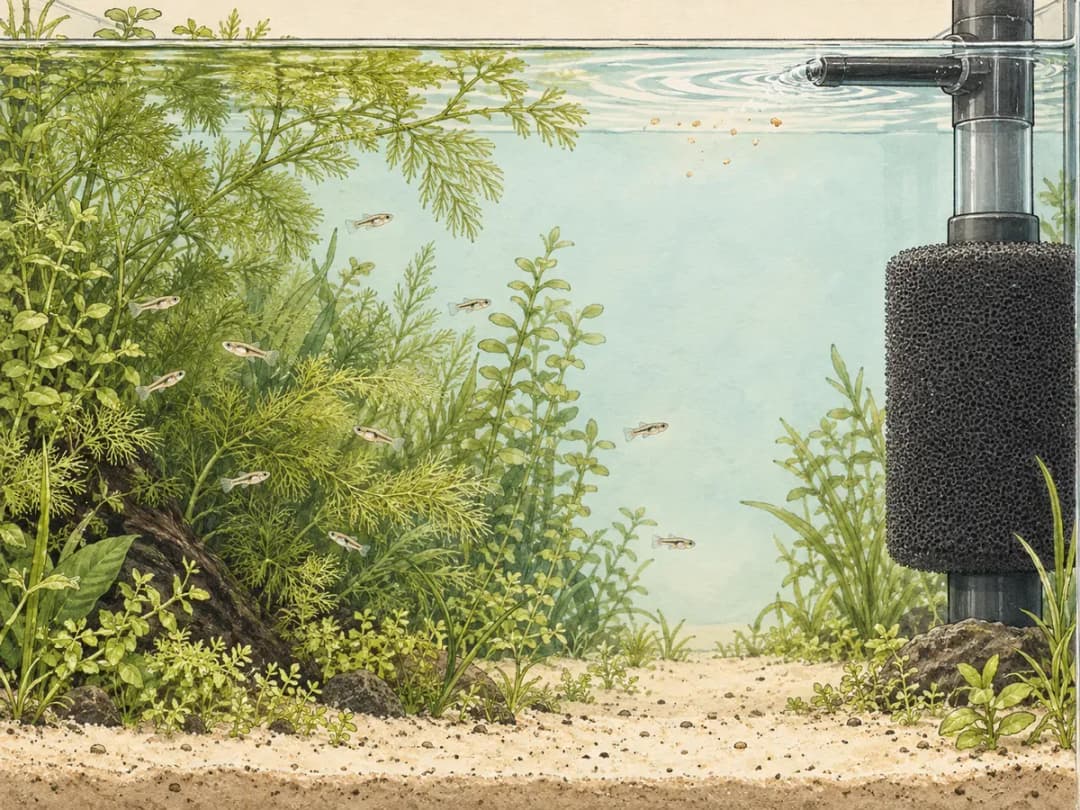
Get to know your water source first. If you use RO water or other low-mineral water, measure GH and KH and remineralize as needed; a pH that looks right doesn't mean the water is suitable. KH is linked to pH stability, while GH mainly reflects hardness from calcium and magnesium. They are different measures, so track both regularly.[1][2]
Let the filter mature in a new tank first, then increase the load gradually after adding fish. Keeping a suitable, steady temperature is easier to manage than raising it sharply in pursuit of faster growth. If you don't want them to breed, you can plan a single-sex group, but still watch for chasing and harassment, and make sure weaker fish have somewhere to rest.
Adults and fry need different feeding frequencies
| Stage | Starting frequency | Adjusting the amount |
|---|---|---|
| Healthy adults | 1 meal a day, or the same daily total split into 2 meals. | Feed small amounts and calibrate against what is actually eaten in a short time and regular body-condition records.[1][3] |
| Growing fry | A practical start is 3 to 4 very small meals a day. | This is a small-and-frequent guideline, not a fixed optimum for all fry; remove leftovers after each meal.[3] |
| Breeding fish or fish in special condition | Adjust individually based on actual feeding and body condition. | Don't feed much more just because a pregnant female's belly is larger, and don't hold all growing fish to the adult baseline. |
The first time you switch an adult to a new food, offer a small portion, watch for about 1 to 2 minutes to see whether it is swallowed easily, note how much is actually eaten, and make sure weaker fish get some too. Use a fixed measuring spoon to establish the daily total for this tank; splitting it into meals only divides it up. If you switch to a smaller pellet, don't carry over the old pellet count: with smaller pellets, the relationship between count and actual weight changes.[3]
Fry food has to be fine enough to fit in their mouths, but finer isn't always better. Confirm they are eating first, then move up in particle size as they grow; too much fine powder lingers in the water and on the bottom. If adults at the top grab the food and the fry miss out, change the feeding spots or raise the fry in a separate space instead of feeding the whole tank more. Frozen or cultured live foods used as supplements count toward the daily total, and their source and hygiene matter.[3]
How to choose guppy food for your needs
Choose between the two based on whether the pellets fit your fish's mouths, your everyday needs and how well the fish actually eat them. The particle sizes above are those listed on the official website and can't guarantee that every newborn fry can swallow them; for newborn fry, choose a fine food that fits their mouths. A higher crude protein figure also doesn't mean you should feed more; the total still depends on growth, body condition and water quality.[4][5]
Water changes should keep up with fish numbers and breeding
For an established, lightly stocked tank, a weekly partial water change of about 20 to 30% is a practical starting schedule, adjusted according to changes in ammonia, nitrite, nitrate and pH. This percentage is an easy-to-follow starting point for management and can't replace water testing. When a grow-out tank is fed small, frequent meals or the number of fry suddenly increases, you will usually need to siphon out leftovers and change water more often.[2][6]
Every day, check water temperature, whether each fish is eating, any chasing and whether there are new fry; deal with leftover food right away.
Test the water weekly and compare it with the hardness of your source water; for a new tank or when something seems wrong, test ammonia and nitrite daily.[2]
Dechlorinate top-up water and match its temperature, so hardness or pH doesn't change quickly all at once.
Clean the intake sponge regularly and maintain filter media in batches; don't wash or replace all the biological media in a fry tank at once.
Guppies breed continuously, so count both adults and fry toward the tank's load. Planning ahead for grow-out containers, a reasonable number to keep and where the rest will go works better than dealing with it after the tank is overcrowded. Breeding boxes are only suitable for short-term use under the right conditions; cramped space and long periods of isolation make care harder.[1]
Observing your fish: more than just bright colors
Each day, check whether fins are spread naturally, breathing is steady, the body is gradually getting thinner, and whether fish keep rubbing against decor, clamp their tails, shimmy or hang at the surface. Changes in a pregnant female's belly can't be told apart from fluid buildup (dropsy) from a photo alone; look at appetite, scales, swimming posture and whether the rest of the group shows problems too. If symptoms persist or a fish suddenly loses balance, test the water and contact a fish veterinarian; white feces alone can't confirm parasites.[1]
Guppy care FAQ
Do guppies always need salt?
Adding salt routinely isn't a standard step. Get temperature, minerals and filtration right first, and if treatment is needed, base it on a diagnosis and on what the other animals in the tank can tolerate.
Can guppies be kept in pure RO water?
Using it straight, without testing or remineralizing, isn't recommended. Guppies do well in water with some mineral content, so check GH, KH and pH together.[1]
Can fry eat adult food?
First make sure the food fits in their mouths. Choose a suitably fine food, or prepare the product into a size they can eat depending on its form, and avoid dropping in lots of powder they can't eat.[3]