
When thread-like organisms hang from a fish, or translucent discs move across its body, consider anchor worms and fish lice. Both are crustacean parasites; the adults you can see with the naked eye are only one part of the life cycle, and larvae or eggs may also be present in the environment.[1][2]
First, tell fixed threads from moving discs
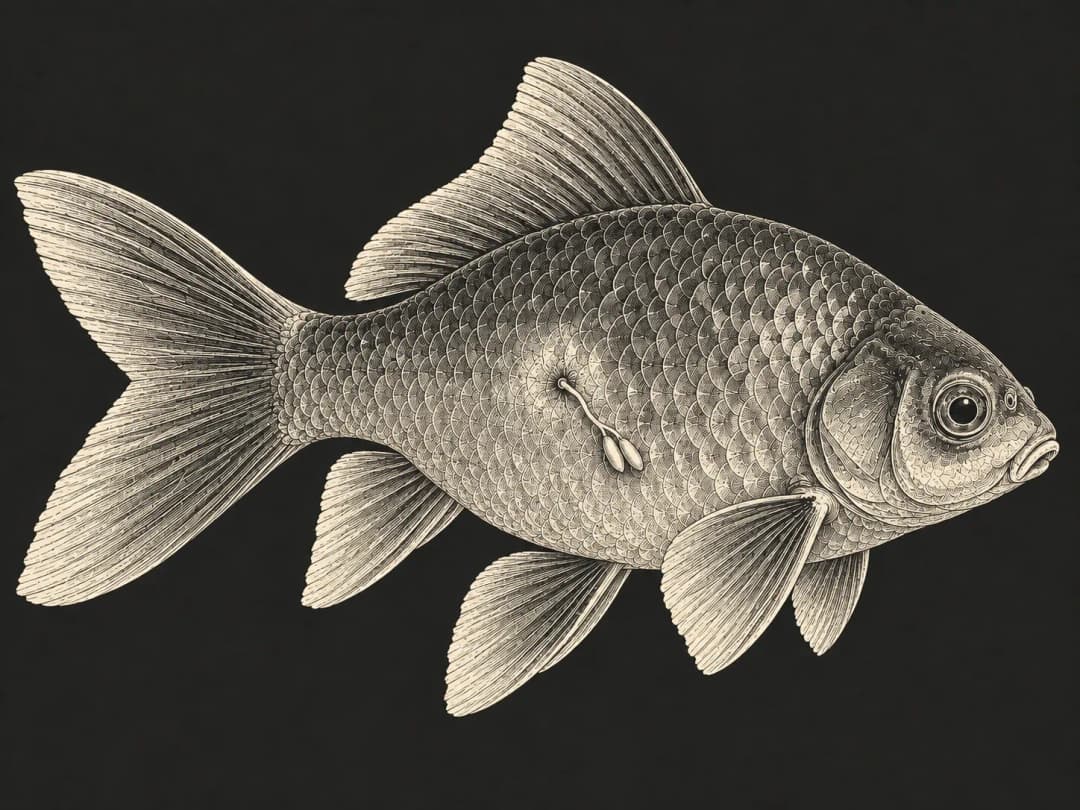
| Feature | Anchor worm Lernaea | Fish louse Argulus |
|---|---|---|
| Group | Copepod crustacean | Branchiuran crustacean |
| Typical appearance | Thread- or hair-like, one end embedded in the fish, often with a pair of egg sacs at the tip | Flat, translucent disc or oval; compound eyes may be visible |
| Common size | UF/IFAS describes visible adult females as about 25 mm long | UF/IFAS describes large larvae and adults of A. foliaceus as about 3–7 mm long; other species may differ in size |
| Do adults move? | Once embedded, females stay attached | Can crawl over the body and swim off the fish |
| Where the eggs are | Paired egg sacs at the female's tail end | Laid by females off the fish on hard surfaces, plants and similar places |
| Easily overlooked stages | Larvae can parasitize the gills | Eggs on tank or pond walls, and parasites not attached to a fish |
Table compiled from UF/IFAS resources.[1][2] Plant fibers and other attached material can also be mistaken for anchor worms; close-up photos can help with an initial discussion, but final confirmation still rests with a professional.
Anchor worm larvae can also damage the gills
Nauplii first live freely in the water, then enter the parasitic copepodid stage. After mating, the female embeds the anchor-shaped structure on her head into the host's tissue and produces paired egg sacs; the thread-like shape owners notice is usually this stage.[1]
UF/IFAS notes that at about 25–30°C the life cycle can take 18 to 25 days, and larval development is limited in colder conditions. However, adult females can overwinter on the host and reproduce again once the water warms, so cold weather or a temporary absence of new parasites can't be taken as proof they're gone.[1]
Attachment sites can bleed, become inflamed and ulcerate, giving bacteria or water mold an opening to infect; heavy larval infestations of the gills can also directly impair breathing and kill small fish. Not all of the risk can be put down to secondary infection.[1]
Fish louse eggs may be hiding in the environment
Fish lice attach to the host with suckers and piercing mouthparts, causing local damage and irritation. Fish may flash, produce more mucus, show pinpoint bleeding, eat less or swim abnormally; the parasites may also drop off when the fish is netted out of the water, so not finding any during an exam doesn't mean none were there.[2]
Females leave the fish to lay eggs, and hatching time depends on the species and water temperature. For example, UF/IFAS lists about 10 days at 35°C and about 61 days at 15°C for A. japonicus; these figures aren't a heating prescription, they simply show that eggs in the environment may persist for a long time.[2]
Fish lice may also carry other pathogens, and heavy infestations can weaken fish and damage the skin and fluid balance. A single infestation won't necessarily spread other diseases, but if ulcers, breathing problems or deaths appear, check for mixed infections.
Why pulling off the parasites isn't enough
Pulling anchor worms out with tweezers can leave the embedded part behind in the tissue. Even after the visible adults are removed, immature parasitic stages may remain in the system; with fish lice, eggs may also remain in the environment.[1][2]
Don't repeatedly pull parasites off large numbers of sick fish yourself. Have a veterinarian assess mechanical removal, wound care and management of the entire connected system; the treatment timeline should cover the relevant life cycle rather than stopping as soon as adults are no longer visible.
Whole-system management and prevention
The water the sick fish was kept in, the other fish, the equipment and the environment all need to be included in the assessment. Cleaning and appropriate disinfection help reduce the pathogen load in the environment, but watch out for disinfectant residue and the capacity of biological filtration.[1][2]
Quarantine new fish first, especially fish from the wild, ponds or other outdoor sources. Also consider whether dedicated equipment, source water and newly introduced plants or wet items could bring in parasitic stages. UF/IFAS notes that fish louse eggs laid in fall can overwinter, so briefly leaving a system empty in cold water isn't a guarantee.[2]
When to see a veterinarian
Consult a vet as soon as possible if there's a heavy infestation, small fish are breathing abnormally or dying, attachment sites are ulcerated, fish keep losing weight, or you can't tell whether it's really a parasite. For preparing a fish for diagnostic submission, see "What to Do When Your Fish Is Sick".
If medication is needed, use a legally registered veterinary drug that's appropriate for the case, following the label and your veterinarian's instructions. Tolerance differs among fish species, systems and other organisms, so don't apply agricultural pesticides or specific aquaculture treatments directly to a home aquarium.
Frequently asked questions
Once the parasites have been pulled off, do I still need to deal with the original tank?
Yes. Larvae or eggs may still be in the environment, so the whole system needs to be assessed.[1][2]
Do fish lice stay on just one fish?
No. They can leave the host and move between fish; after leaving the fish, females lay eggs on hard surfaces, plants and similar places.[2]
Further reading
- What to Do When Your Fish Is Sick – Reading Aquarium Fish Symptoms and What to Do First
- How to Quarantine New Fish – Isolating for at Least 30 Days and Acclimating Fish to the Tank
- Columnaris Disease Symptoms – Recognizing Rotting Gills and Fins and Cottony Growth on the Mouth
- Is White Fuzz on Your Fish Water Mold? – Wound Infections and Why Fish Eggs Grow Fuzz