
When milky or grayish-white, wart-like nodules appear on a fish's fins or skin, lymphocystis disease is one possible cause. Its pathogen is different from that of ich (white spot disease, caused by Ichthyophthirius), but the two can look similar early on; bacterial lesions, attached organisms and tumors can also be confused with it. Identify the lesion first and then decide what to do; don't medicate for ich just because you see white bumps.[1]
What is lymphocystis disease
Lymphocystis disease is caused by lymphocystis virus (Lymphocystivirus), a member of the iridovirus family. The lesions are clusters of cells that have become greatly enlarged after infection, most often on the fins and skin, though the gills and other sites can also be affected. They are not white parasite eggs hanging on the fish's body.[1]
Susceptibility and the course of the disease vary between species, so a case in one fish shouldn't be applied to every aquarium fish. According to UF/IFAS, catfish, cyprinids (such as goldfish) and salmonids are not affected by lymphocystis disease, so wart-like nodules on these fish should be checked for other causes.[1] When the species, the distribution of the lesions or the course of the illness doesn't fit the typical picture, a broader differential diagnosis is even more important.
What clues appearance can give
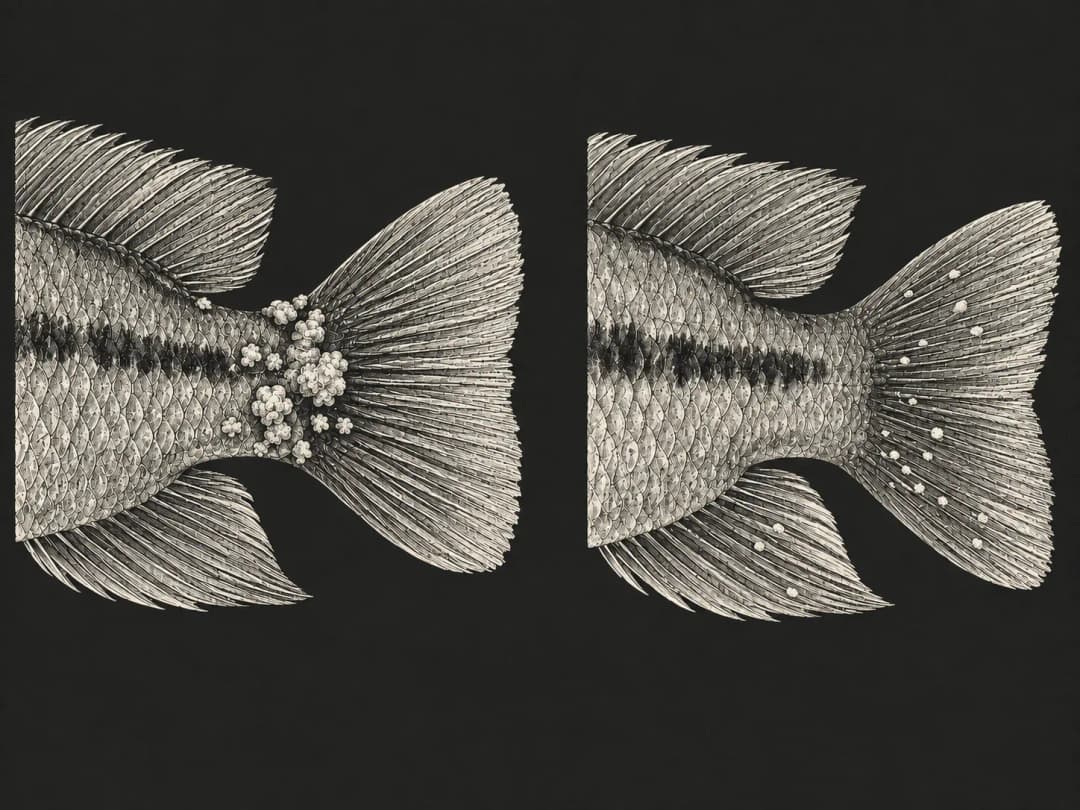
Nodules may look irregular, wart-like or clustered, and their size and color vary. Keepers can take photos to track whether lesions grow, merge or break open, and record swimming, appetite and breathing.[1]
| What you see | What to consider |
|---|---|
| Scattered white spots like grains of salt | Ich and other parasites, plus other similar lesions. |
| Irregular, wart-like nodules | Lymphocystis disease and other tissue growths. |
| Fluffy, cotton-like growth | Water mold or other attached organisms. |
| A single lump that keeps growing over time | Needs testing for tumors and other tissue changes. |
This table only points you in a direction. Early lymphocystis nodules can be confused with white spot, other parasites or bacterial lesions, and appearance alone can't confirm the diagnosis.[1]
How to confirm whether it's a viral nodule
Fish health professionals can examine fresh samples of the lesion to check for the typical enlarged cells, and arrange histopathology or molecular testing if needed. Different tests serve different purposes and cost different amounts, so ask the receiving lab first.[1][4]
Don't cut off nodules yourself as a treatment, and don't equate removing the surface growths with clearing the infection. Repeated netting, cutting or squeezing can create more wounds and make later assessment harder.
What to watch for during care
In some cases the lesions gradually regress once husbandry improves, but there's no guarantee that every fish will recover within a set number of days. There is currently no reliable general treatment guaranteed to speed up regression, so care should focus on managing water quality, nutrition, stocking density and stress.[1]
If nodules affect the gills, feeding or swimming, or if wounds and secondary infections appear, the priorities change. These fish need a veterinary assessment; don't keep waiting just because the disease is often self-limiting.
Keep conditions stable and suited to the species, remove uneaten food, and avoid aggression and repeated moving. If the fish is still eating normally, offer a complete food suited to its diet and watch how much it actually swallows; feeding more doesn't mean better care.[1][3]
Does the fish need to be isolated
Lymphocystis disease can spread through contact between fish or with infected tissue. Quarantining new fish, keeping equipment separate and reducing wounds all help lower the chance of bringing it in and spreading it.[1][5]
Whether to isolate depends on the condition of the affected fish, the species, contact with tankmates and how mature the isolation system is. Even after the nodules disappear, you can't declare from appearance alone that there's no risk of transmission at all; follow your veterinarian's advice on next steps.
Frequently asked questions
Is lymphocystis disease the same as fish cancer?
No. It's an enlargement of cells caused by viral infection; however, some tumors can look similar, so it still needs to be differentiated.[1]
Can antibiotics get rid of the nodules?
Antibiotics don't target the virus that causes this disease. If there's a secondary bacterial infection, whether antibacterial treatment is needed is a separate question that has to be confirmed.
Can I just treat it like ich?
No. Ich is a parasitic infection, while lymphocystis disease is caused by a virus; the pathogens and the approach are different, so examine the lesions first to avoid the wrong treatment.[1][2]
If the fish is eating as usual, does it not need checking at all?
Normal eating is worth recording, but it can't confirm what the disease is. If nodules multiply quickly, break open or affect breathing, seek help early.
Further reading
- What to Do When Your Fish Is Sick – Reading Aquarium Fish Symptoms and What to Do First
- How to Quarantine New Fish – Isolating for at Least 30 Days and Acclimating Fish to the Tank
- White Spot Disease (Ich) in Freshwater Fish – The Ichthyophthirius Life Cycle and Why It Keeps Coming Back
- Is White Fuzz on Your Fish Water Mold? – Wound Infections and Why Fish Eggs Grow Fuzz
- Popeye and Cloudy Eyes in Fish – Sorting Out Eye Injuries, Water Quality and Infection
References
- Yanong RPE. Lymphocystis Disease in Fish. UF/IFAS, FA181, 2010 (revised 2024).
- Petty BD, Francis-Floyd R, Yanong RPE. Parasitic Diseases of Fish. Merck Veterinary Manual, revised 2022.
- Francis-Floyd R, Stilwell NK, Yanong RPE. Introduction to Fish Health Management. UF/IFAS, CIR921/FA004, 1990 (revised 2025).
- Stilwell NK, Yanong RPE, Francis-Floyd R. Submission of Fish for Diagnostic Evaluation. UF/IFAS, FA055, 2001 (revised 2025).
- Petty BD, Francis-Floyd R, Yanong RPE. Management of Aquarium Fish. Merck Veterinary Manual, revised 2022.