When pits, loss of color and erosion appear on a fish's head or along its lateral line, it's often called hole-in-the-head disease. HITH in freshwater cichlids and HLLE in marine fish shouldn't be assumed to share the same cause, and current data aren't enough to explain every case with a single cause.[3][5] A study in channel catfish also noted that what is described as HLLE in different species varies widely in pathology and possible causes, making it look more like a clinical sign than a single disease.[1]
First record the species, where the lesions are, how they're progressing, body condition and water quality. If there's weight loss, refusal to eat, rapidly spreading ulcers or several fish affected, have a veterinarian examine the fish. Don't conclude it's intestinal flagellates just from the pits, and don't treat a change of food as a cure.
Hole-in-the-head disease isn't the same as normal sensory pores
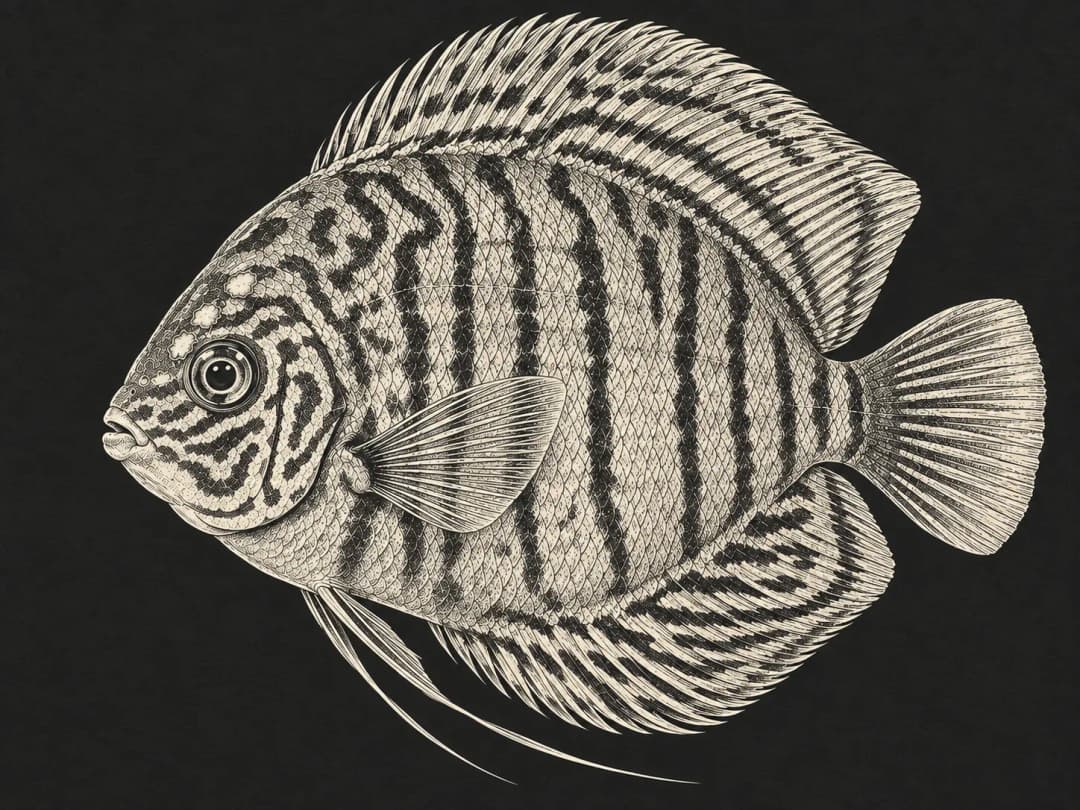
Fish naturally have a sensory system on the head and along the lateral line. Lesions often show up as damaged tissue around the pores, loss of color, and pores that enlarge or merge; loss of color was described in a channel catfish study[1], and enlarging and merging in a study of marine surgeonfish[4]. Compare with the fish's normal appearance, earlier photos and other fish of the same species, then have a professional confirm.
The distribution and pathology of lesions can differ between species. "Hole in the head" describes appearance; erosion, injury, infection and other skin conditions still need to be told apart.
How the evidence for the different hypotheses compares
| Hypothesis | What the current evidence supports | Main limitations |
|---|---|---|
| Activated carbon | Controlled trials with specific marine surgeonfish and activated carbon setups could induce lesions | Limited to certain species and methods of use; can't be generalized to all hole-in-the-head disease. |
| Flagellates | Spironucleus has been isolated from the lesions and internal organs of some affected cichlids | Finding them together doesn't prove cause and effect, and healthy fish can also carry the parasites. |
| Calcium–phosphorus imbalance | A controlled trial in discus did not induce hole-in-the-head over 16 weeks | A negative result from a small sample can't rule out all nutritional problems. |
| Vitamins and water quality | Hypotheses raised in the literature (see the introduction of [5]) | The studies cited here didn't directly test vitamins, and water quality was only covered by water hardness in [5], so no general causal conclusion can be drawn yet. |
The table is an interpretation of the evidence based on the study designs below, not a unified disease grading: for the activated carbon row see [3][4], the flagellate row [2][5], the calcium–phosphorus row [5], and for the vitamin and water quality hypotheses the introduction of [5].
Activated carbon has experimental support, but only within a limited scope
Hemdal and Odum's study used three marine systems, with only one system per treatment; all 12 ocean surgeon (Acanthurus bahianus, family Acanthuridae) in the lignite activated carbon group developed obvious lesions, the pelletized carbon group had microscopic lesions, and the no-carbon control group showed none.[3]
In this study, all the fish in a given treatment were in the same system, so the 12 fish can't be treated as 12 independent replicate systems. Treatment effects may still be tangled up with differences between the systems, a limitation to keep in mind when judging how strong the evidence is.
In another experiment, by Stamper et al., with three control systems and three activated carbon systems, filtering seawater at full flow through extruded coconut-shell activated carbon induced lesions in the same species; after the carbon was removed, the lesions reversed in about 49 days on average.[4] Together, the two studies support a risk for specific species and setups, but they don't establish the full mechanism of disease.
For susceptible marine fish, it's worth reviewing the type of activated carbon, the amount, flow rate and how it's used; but this doesn't show that freshwater fish such as discus and angelfish share the same mechanism. Nor can the 49-day improvement time be applied directly.
Finding flagellates doesn't mean they caused the holes
Paull and Matthews isolated Spironucleus vortens from hole-in-the-head cases and proposed it as a possible cause; but this was a case observation that didn't complete a causal test reproducing all the lesions through experimental infection, and the only control was a single angelfish with no history of hole-in-the-head.[2]
In other studies of kept discus, fish with intestinal flagellates detected could also be free of hole-in-the-head.[5] So simply carrying gut parasites, intestinal disease and systemic problems should be distinguished; neither abnormal feces nor the holes themselves are grounds for medicating straight away.
What negative results from nutrition research mean
A 2019 discus experiment combined different diets and water hardness, with four groups of five fish observed for 16 weeks, and didn't induce hole-in-the-head. The result shows the disease couldn't be reproduced under that study's conditions; it doesn't prove that no nutritional deficiency is involved, nor that any particular food can prevent hole-in-the-head.[5]
Complete nutrition, appropriate feeding and a good environment are the foundation of fish health management; that general principle is on a different level from "a product can treat hole-in-the-head." The studies above aren't enough to support general claims that any specific food or supplement prevents or treats it.
What keepers can do now
First test water quality, check for overcrowding and ongoing stress, record the actual type of food, how it's stored and appetite, and provide photos of the lesions. If you use activated carbon with susceptible marine fish, record the product type, amount and flow setup for your veterinarian to assess.[3][4][6]
Managing the environment can improve the factors you can adjust, but if lesions spread quickly or body condition declines, have the fish examined promptly, rather than cycling through antiparasitics, antibacterials and nutritional supplements and losing any basis for judgment.
Frequently asked questions
Should every aquarium stop using activated carbon?
An experiment on a single species can't set rules for every aquarium. Assess it by species, purpose and the specific way it's used.[3][4]
Does finding flagellates prove the cause of the holes?
Not necessarily. Sampling site, clinical signs and other tests need to be considered together to tell carrying the parasite apart from it causing disease.[2][5]
Will adding vitamins or switching food definitely fix it?
There's no general guarantee supported by the studies above. If a nutritional problem is confirmed, correct it sensibly, but check for other causes too.
If medication is needed, use a legally registered veterinary drug that's appropriate for the case, following the label and your veterinarian's instructions.
Further reading
- What to Do When Your Fish Is Sick – Reading Aquarium Fish Symptoms and What to Do First
- Ammonia and Nitrite Poisoning – Fish Gasping at the Surface and How to Read Water Test Kits
- How to Quarantine New Fish – Isolating for at Least 30 Days and Acclimating Fish to the Tank
References
- Corrales J, Ullal AJ, Noga EJ. Lateral line depigmentation (LLD) in channel catfish, Ictalurus punctatus (Rafinesque). Journal of Fish Diseases 32, 705–712, 2009. doi:10.1111/j.1365-2761.2009.01069.x.
- Paull GC, Matthews RA. Spironucleus vortens, a possible cause of hole-in-the-head disease in cichlids. Diseases of Aquatic Organisms 45, 197–202, 2001. doi:10.3354/dao045197.
- Hemdal J, Odum RA. The Role of Activated Lignite Carbon in the Development of Head and Lateral Line Erosion in the Ocean Surgeon. North American Journal of Aquaculture 73, 489–492, 2011. doi:10.1080/15222055.2011.635781.
- Stamper MA et al. Effects of Full-Stream Carbon Filtration on the Development of Head and Lateral Line Erosion Syndrome (HLLES) in Ocean Surgeon. Journal of Aquatic Animal Health 23, 111–116, 2011. doi:10.1080/08997659.2011.608608.
- Amesberger-Freitag A et al. Hole-in-the-head disease in discus fish, Symphysodon (Heckel, 1840): Is it a consequence of a dietary Ca/P imbalance? Journal of Fish Diseases 42, 1133–1142, 2019. doi:10.1111/jfd.13023.
- Francis-Floyd R, Stilwell NK, Yanong RPE. Introduction to Fish Health Management. UF/IFAS, CIR921/FA004, 1990 (revised 2025).