
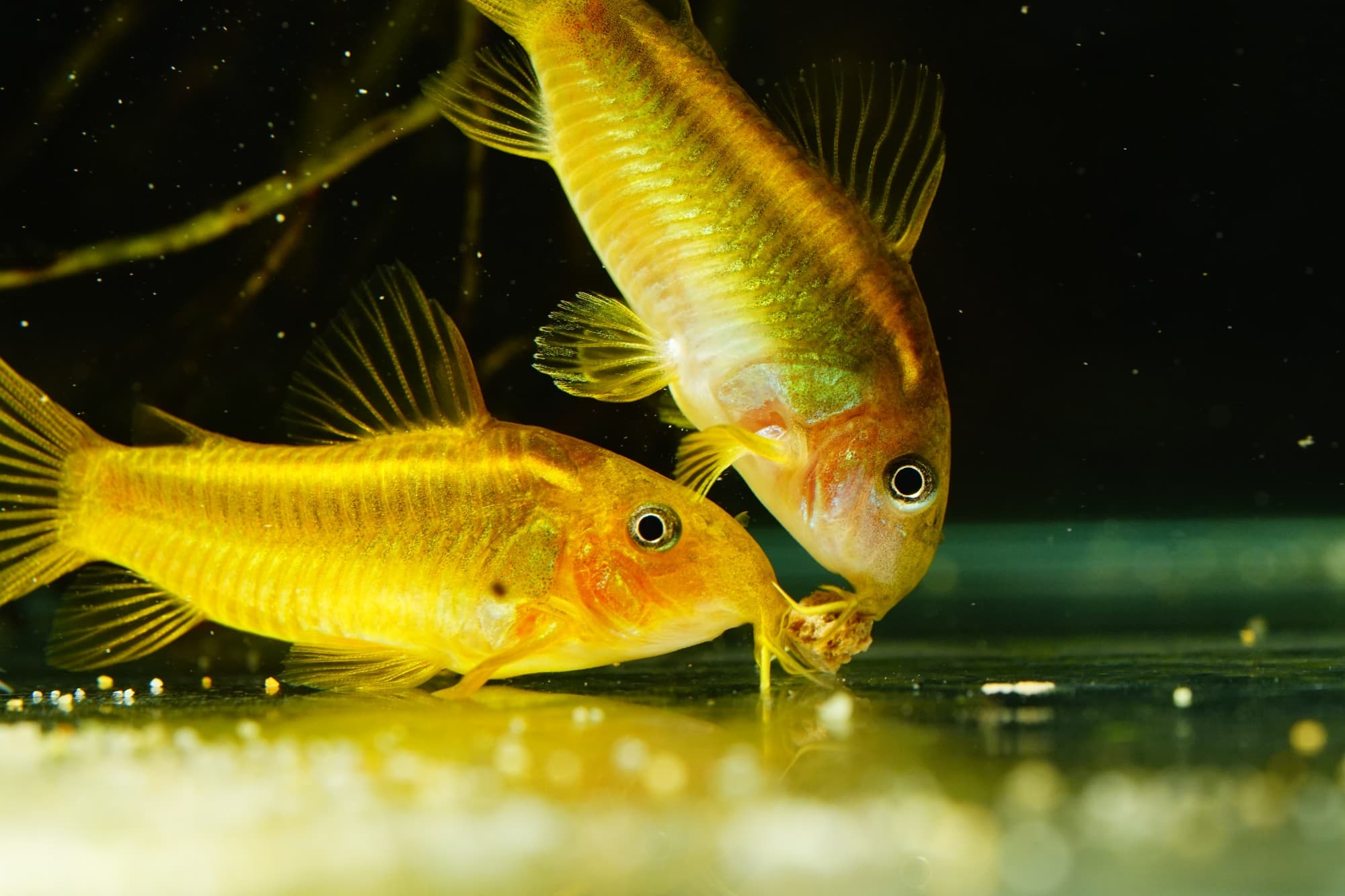
Corydoras rummaging along the bottom doesn't mean they can live on other fish's leftovers. They need suitable companions of their own species, a clean bottom and planned feedings of sinking food. "Corydoras" covers many different species, and their temperature and space needs differ, so note the correct common and scientific name when you buy them before settling on water temperature and tankmates.[1]
Plan the group and the space first
| Item | How to plan it |
|---|---|
| Group | At least 5 of the same species, per the source; you can plan for 6 or more, as long as the space grows to match.[1] |
| Tank | A typical small corydoras group can start at around 80 liters; floor area matters most.[1] |
| Substrate | A smooth, easy-to-clean fine sand area makes foraging easier; avoid sharp substrates. |
| Water temperature | Confirm by species; a warm tropical setup is not a universal standard for all corydoras. |
| Feeding | Start with one dedicated sinking staple a day, spread across several spots, and check each fish. |
| Maintenance | Remove leftover food and waste from the bottom; keep track of water quality and oxygen. |
Plan substrate and cover together
The bottom of the tank is where corydoras spend most of their time, so first keep an open stretch of floor where the group can forage together, then add plants and smooth driftwood for cover. When choosing fine sand, check whether the grains are sharp; don't go by the product name alone. Keep the sand layer to a depth that is easy to maintain, so waste isn't buried for long periods where it is hard to clean out. The fine sand and zoning described here are practical design choices based on bottom-foraging behavior.[1]
Corydoras have barbels, and problems with waste building up on the bottom shouldn't be reduced to "the sand is too coarse." If barbels shorten, redden or look damaged, check water quality, cleaning, substrate and possible infection together. Set up a smooth feeding area, reduce physical abrasion, and keep watching for changes rather than stopping once the sand has been replaced.
Aim for water flow that keeps water circulating and the surface moving while still letting the fish settle and forage normally. Keep a clear path to the surface. Rather than looking only at tank volume, watch whether the floor area can hold the whole group and whether there is enough room to retreat.[1]
Corydoras shouldn't all be kept at 28°C
Start by confirming the species. Taking the common peppered cory as an example, FishBase lists a temperature range of 18 to 23°C, a species reference that reminds us not to plan every corydoras tank around 28°C. This is neither a measured tolerance limit from the wild nor an optimal-temperature trial for every captive strain, so it can't be used to conclude that going outside the range will inevitably cause disease. Look up reliable data for other species separately, and before mixing them, make sure the conditions for all the fish overlap.[2]
In an established tank, the management target for ammonia and nitrite is undetectable, and pH and hardness should also be confirmed by species. Seeing sand, plants and clear water in a new tank doesn't mean it is ready for fish; the biological filtration must be able to handle the actual waste and feeding load.[3][4]
Make sure every corydoras gets its share
A healthy adult group can start with one feeding a day of a dedicated sinking staple, at a time when the whole group comes out to forage. Growing fish can have the amount split into more small meals, with the total calibrated against how much they actually eat, their body condition and water quality. In a community tank, first make sure the food reaches the bottom and isn't all intercepted by other fish; don't just feed the upper-level fish more and hope the leftovers sink.[1][5]
If the wafers are large, break them into smaller pieces and drop them in several separate spots so that less dominant fish can get some too. Offer a small amount the first time, check after about 10 minutes whether every fish is eating, and look for leftovers at around 30 minutes. Thirty minutes is a feeding-observation reference that can be used for some slow-eating catfish, not a rule that food must stay in for the full 30 minutes; if the food breaks apart, the fish stop eating or there is obviously food left, remove it sooner.[1]
Note how much goes in for the whole group and how much is left, and check each fish's belly profile. Say a tank normally finishes one wafer a day: splitting it into two meals means dividing that one wafer, not giving a whole wafer in the morning and another in the evening. When you want to feed more, change only one thing at a time, and keep comparing water quality, body condition and whether fish are competing for food.
Choose corydoras food that sinks and fits their mouths
TROPICAL shrimp pie sinks, making it easy to set up feeding spots on the bottom. The roughly 6.2 mm figure is the diameter of the wafer, and not every corydoras can swallow one whole; break it up to suit the size of your fish, and watch whether they can nibble it and whether each fish gets some. The product is also labeled for some carnivorous plecos, but that doesn't mean corydoras and all plecos have identical nutritional needs.[6]
Maintenance in a corydoras tank centers on the bottom
Remove uneaten food every day, and check for waste collecting around feeding areas and cover.
Test the water weekly. A partial water change of about 20 to 30% is a practical starting schedule; adjust it to how quickly waste accumulates. These numbers are not a fixed standard for every tank.[3][4]
Vacuum the bottom one section at a time, and avoid thoroughly washing all the sand and biological filter media on the same day.
Check the filter intake and flow, and increase surface agitation if needed; when there are fry, add a suitable intake guard.
Keeping a same-species group doesn't mean you can add fish quickly; every addition needs to account for filtration capacity and space.[1]
Darting to the surface: normal air gulping or a warning sign?
Studies of the bronze cory (Corydoras aeneus) show that its hindgut has structures for supplementary air breathing, and that trips to the surface to breathe are influenced by both low oxygen and group behavior. An occasional quick dash to the surface followed by a return to the bottom therefore can't on its own be taken as a sign of oxygen shortage. But if the whole group suddenly surfaces often, gills move rapidly or fish hang at the surface, check dissolved oxygen, water temperature and water quality, improve aeration promptly and contact a fish veterinarian.[7][8]
At a set time each day, compare whether the fish are willing to forage, whether bellies are gradually sinking in, whether barbels are intact and whether there are new injuries on the body or fins. A fish that is repeatedly chased away from food, keeps refusing to eat or breathes abnormally should never be overlooked just because the others in the tank seem fine. Regularly film short side-on and bottom-level clips and review them alongside your actual feeding records.[1]
Corydoras care FAQ
Corydoras are cleaner fish, so do they need to be fed at all?
They do need to be fed suitable sinking food on purpose. They won't clean the tank of pollutants, and leftovers can't be relied on for proper nutrition.[1]
Does buying one each of several species count as a group?
It isn't a good substitute for a same-species group. Start with a reference group of at least 5 of one species, then consider other companions based on tank space.[1]
Further reading
References
- OATA: freshwater catfish care
- FishBase Hoplisoma paleatum: peppered cory species profile
- Merck Veterinary Manual: water quality testing and monitoring frequency
- OATA: freshwater aquarium setup and maintenance
- UF IFAS Fish Nutrition
- Ultra Fresh TROPICAL shrimp pie
- Podkowa and Goniakowska Witalińska 2002: intestinal air breathing in corydoras
- Pineda et al. 2020: air-breathing trips to the surface and social behavior in corydoras