
A goldfish that flips belly-up, floats at the surface and can't get down, or lies on the bottom and can't rise is often said to have swim bladder disease. These signs only tell you that the fish can't maintain normal buoyancy or posture; the real cause may be the swim bladder itself, or the kidneys, a mass or problems with other organs.[1][4]
What to do first when a fish turns belly-up
First check water quality, aeration and filtration, and record when it started, whether it's constant, and whether there's refusal to eat, a swollen belly, asymmetry between the left and right sides, bleeding or rapid breathing. When several fish are affected at once, environmental problems are especially important to rule out.
If the fish can't keep a normal posture for an extended time, can't feed, or shows other obvious problems, see a veterinarian as soon as possible. Don't puncture the swim bladder or belly yourself, and don't delay an examination by repeatedly trying home remedies such as fasting, feeding peas or various water additives.
Separate buoyancy disorders from neurological loss of balance
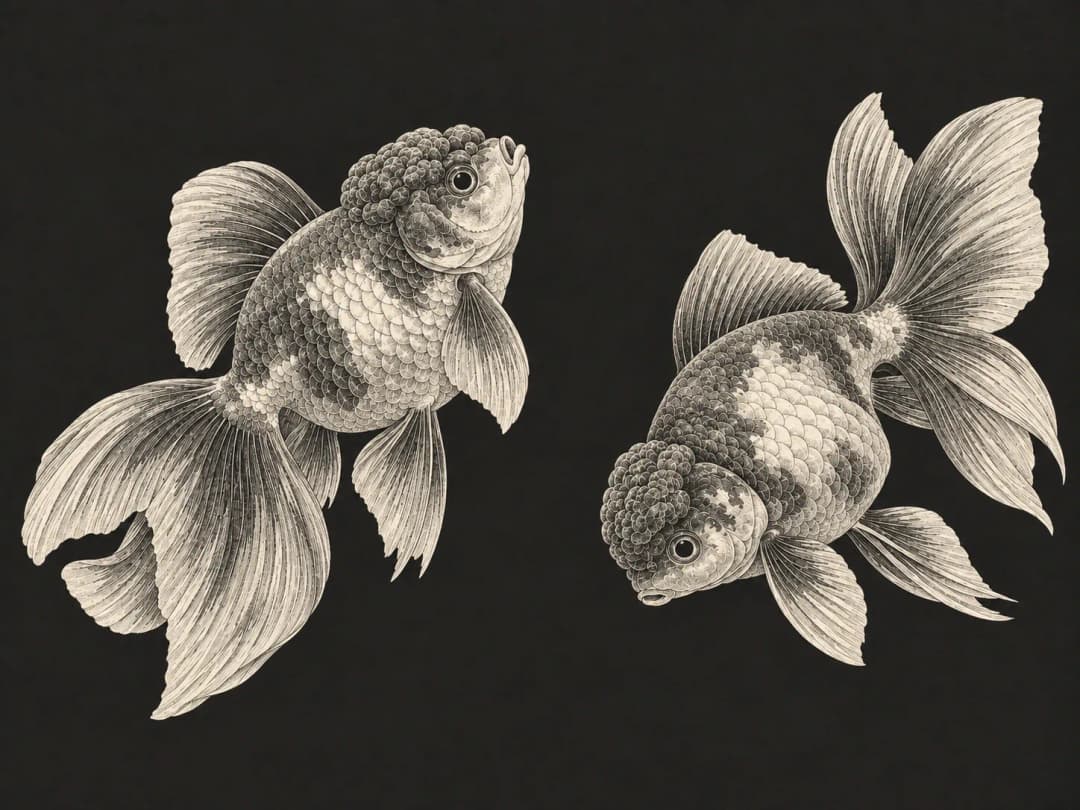
With positive buoyancy, the fish stays floating at the surface even when resting; with negative buoyancy, it may sink to the bottom. Swimming head-down, tilting to one side or rolling over can also come with either of these.[1]
Spinning, twitching or disorientation also call for considering neurological problems, toxic water conditions or other diseases.[2][5] Keepers can record video for the veterinarian; not every odd swimming posture can be put down to swim bladder disease.
The swim bladder and nearby organs both affect posture
The swim bladder helps fish maintain buoyancy by adjusting the gas inside it. Cyprinids (including goldfish) have a two-chambered swim bladder; in some species the swim bladder connects directly to the digestive tract and in others it doesn't, so the structure varies between species.[2]
Fluid in the swim bladder, overinflation, inflammation, rupture or displacement can all affect buoyancy. Even when the swim bladder itself has no primary disease, pressure from nearby kidneys or a mass can change its position and the fish's balance.[1][4]
Possible causes and the tests needed
| Possible direction | Changes that can occur | How it's assessed |
|---|---|---|
| Swim bladder infection or inflammation | Fluid in the swim bladder, tissue changes; some cases involve bacteria or fungi | Imaging such as X-rays and ultrasound; other tests as the veterinarian decides. |
| Kidney disease or a mass | Enlarged organs pressing on or moving the swim bladder | Imaging such as X-rays and ultrasound; other tests as the veterinarian decides. |
| Swim bladder overinflation or rupture | Abnormal gas distribution and outline | Imaging such as X-rays, together with the fish's condition. |
| Gas or blockage in the gut | Abnormal gas or contents in the digestive tract | Imaging, other tests as the veterinarian decides; can't be inferred from appetite alone. |
| Fluid in the body cavity and other internal disease | Swollen belly, which may occur alongside abnormal posture | Imaging and tests aimed at the underlying cause. |
This list is based on veterinary clinical literature.[1][4] How often each cause occurs varies with the species and the population seen at clinics, so it can't be read as a ranking of likelihood for home aquariums.
Are round-bodied goldfish always prone to flipping over
Buoyancy problems are seen more often in the clinic in some fancy goldfish.[1] Some literature suggests this may be related to changes in body shape caused by selective breeding and genetics.[3] However, in one review of veterinary clinical cases, the numbers of short-bodied and long-bodied goldfish cases were nearly equal, so you can't assume every case of flipping over is caused by the breed.[4]
Quantifying the risk for different varieties still needs appropriate comparison data. Round-bodied fish with problems should be examined, and in long-bodied fish internal disease can't be ruled out either.
How reliable are the claims about floating food, constipation and peas
| Common claim | A more accurate reading |
|---|---|
| Eating floating food always makes fish swallow air and flip over | Can't be assumed. Diet and gas mechanisms have been proposed, but they aren't enough to explain every buoyancy disorder.[3] |
| Flipping over always means constipation | Gut blockage or gas is one possibility to consider, but the swim bladder, kidneys and other problems are possible too. |
| Feeding peas is a treatment | Clinical reports describe keepers trying this, but it can't be taken as a general cure. |
| Switching to sinking food prevents it | Can't be assumed. The link between food type and buoyancy disorders is only a proposed hypothesis; it can't guarantee that changing food will prevent problems, and it can't replace testing for the cause.[3] |
These claims should be checked against the actual cause. If a particular fish has problems after every meal, record the type of food, the amount and when it happens for your veterinarian to assess; a link in timing alone doesn't prove the cause.[1][3]
Imaging and outlook
X-rays can show the gas distribution, outline and position of the swim bladder, and ultrasound and similar methods can help assess fluid, masses and other organs.[1][4] Whether further tests are needed is up to the veterinarian case by case; not every case needs the same set of tests.
Cases that already have serious internal disease may have poorer outcomes. In one review of veterinary clinical cases, most affected fish had already been euthanized because their disease had progressed by the time they were seen, and they also responded poorly to treatment.[1][4] But this kind of late-stage clinic data can't be taken as the outlook for every fish that has just started flipping over. Whether a fish can improve depends on the cause, the damage and how far the disease has progressed; having a veterinarian examine it early gives the best chance of finding a treatable problem.
Frequently asked questions
If the fish returns to normal after I stop feeding for a while, does that prove it was constipation?
No. Short-term changes can be affected by many factors, and a single improvement can't confirm the cause; if it keeps happening, record it and have the fish examined.
If the fish can still eat, can I just keep watching?
A normal appetite doesn't prove there's no internal disease. If the problem persists, gets worse or affects breathing, see a vet.
Can I let the air out of the swim bladder myself?
No. The structure and cause need to be confirmed and assessed by a veterinarian first; puncturing it yourself risks harming the fish.
If medication is needed, use a legally registered veterinary drug that's appropriate for the case, following the label and your veterinarian's instructions. For how to prepare for a vet visit and submit samples, see "What to Do When Your Fish Is Sick".
Further reading
- What to Do When Your Fish Is Sick – Reading Aquarium Fish Symptoms and What to Do First
- Ammonia and Nitrite Poisoning – Fish Gasping at the Surface and How to Read Water Test Kits
- Causes of Dropsy and Raised Scales in Fish – How to Assess a Swollen Belly and Pinecone Scales
References
- Wildgoose WH. Internal diseases of ornamental fish a clinical approach. Bulletin of the European Association of Fish Pathologists 26, 46–47, 2006 (workshop summary).
- Petty BD, Francis-Floyd R, Yanong RPE. Management of Aquarium Fish. Merck Veterinary Manual, revised 2022.
- Mayer J, Donnelly TM eds. Swim bladder disease/buoyancy disorders. Clinical Veterinary Advisor: Birds and Exotic Pets. W.B. Saunders, 2013, pp. 36–37. doi:10.1016/B978-1-4160-3969-3.00025-1.
- Wildgoose WH. Buoyancy disorders of ornamental fish: a review of cases seen in veterinary practice. Fish Veterinary Journal 9, 21–37, 2007.
- Francis-Floyd R, Yanong RPE, Petty BD. Environmental Diseases of Aquatic Animals in Aquatic Systems. Merck Veterinary Manual, revised 2023.