
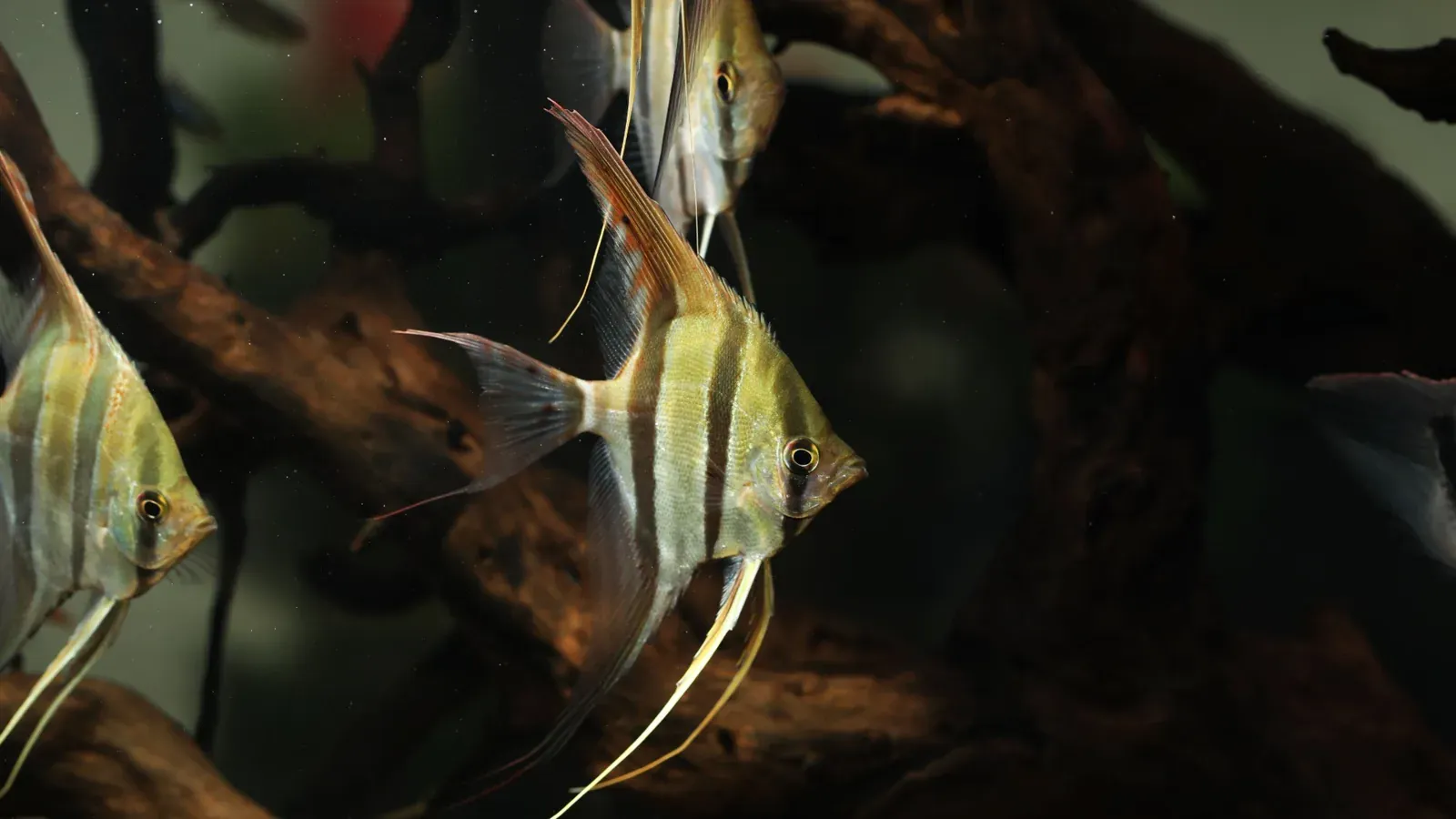
Breeding altum angelfish means observing pairing, spawning, fertilization, hatching and rearing as separate stages. Laying eggs is only one step; broodstock health, interaction, equipment and the later food supply all affect how things are managed. Set up daily care and record-keeping before you start, so you can tell at which stage a problem occurs.
Telling males from females and pairing takes continuous observation
Relying only on body height, head profile or photos of extended fins makes it easy to mistake individual differences for sex differences. Reproductive features that appear close to spawning can be interpreted together with records of actual spawning and embryo development; age, body condition and posture still affect appearance. Observe mainly through video taken from outside the tank and natural behavior, and don't repeatedly catch fish, press on their bellies or take them out of the water to check their genital area.[1]
Two fish that often stay close together aren't yet proof of a male-female pair ready to breed. Keep recording whether they share a fixed area and clean a spawning surface, and how they interact with each other and with tankmates. Whether things calm down after chasing, whether both fish can eat and whether there are persistent injuries are all useful management clues; territorial defense and competition also involve chasing, so it can't all be treated as courtship.[1][2]
Maturity can't be judged by age alone, either. The fish's source, growth, nutrition and health all need to be assessed together; if a fish keeps losing weight, hasn't settled in yet or has been under pressure for a long time, improve its daily care first. Increasing food, raising the temperature and changing the environment all at once to hurry breeding can add stress and also make results hard to interpret.[3]
Get broodstock care and the breeding tank ready first
Broodstock should be feeding normally and consistently, with no untreated obvious injuries or unusual weight loss. Fish from a new source should first complete a separate observation period and any necessary health assessment. Keep records of source water, tank water, measurement methods, food and body condition; prepare hatching or rearing space, siphoning supplies, intake guards and a first-food supply before breeding, so you don't have to move fry at short notice once they appear.[4]
For broodstock that already accept prepared foods and have a suitable mouth size, Ultra Fresh TROPICAL excellent bits can be an option for regular meals. Adjust based on what the fish actually swallow, leftovers and body condition, and keep amounts manageable. More food doesn't translate directly into more fertilized eggs, and the product information in this article doesn't mean the food has been through breeding-performance trials specifically for altum angelfish.[5]
Provide sturdy, safe leaves or aquarium spawning substrates that are easy to observe and clean, and keep the egg area away from equipment suction and strong currents. Arrange driftwood, cover and open swimming space so that a fish being chased has chances to retreat and eat. If the broodstock start defending a fixed spot, plan a divider or separate tanks depending on how much conflict there is, and make sure the divider material won't catch fins or interfere with oxygenation.[1]
Keep water quality and seasonal cases tied to their original conditions
The pH, water temperature, water source and equipment used by the different breeders in the book aren't all the same. Successful cases can help you check your own preparations, but they can't be combined into one set of parameters that guarantees success. Before breeding, confirm the conditions your fish have already settled into, record every adjustment and the reason for it, and avoid changing water quality, lighting, food and tankmates on the same day.[1][2]
"Simulate the rainy season by lowering the temperature" isn't something to apply directly either. On p. 269 of Linke's book, water temperatures at four sites in February and June 2017 didn't all move in the same direction, and pH didn't shift the same way at every site. Location, sampling time, water depth and measurement method are all part of a reading; seasonal change in the wild also involves water level, flow, cover and food, and changing one number in a home tank doesn't recreate all of those conditions.[1]
In captivity, first keep feeding and water quality stable, then build up data across batches. Sudden temperature drops, sudden pH drops or abrupt large water changes are not substitutes for maturity and pairing. If you want to evaluate a particular condition, write down in advance what you'll adjust and which stage you'll observe, and record spawning, fertilization, hatching and rearing results separately.[3]
When eggs turn white, first note the timing and extent
After spawning ends, record the time, water temperature, substrate and broodstock behavior, and track changes in the eggs from similar angles and under similar lighting. Note whether the whitening is scattered, concentrated in one area or covers nearly the whole clutch, and, where you can see clearly, whether embryos are developing. Photos shouldn't come at the cost of repeatedly moving the substrate, taking eggs out of the water or disturbing the parents with strong light.[1]
Describe "eggs turning white" and "fuzzy growth appearing" separately. Failed fertilization, arrested development and subsequent microbial growth can happen one after another; a photo alone can't confirm which microorganism is involved or which factor first caused the eggs to die. If many eggs change around the same time, review water changes, equipment interruptions, oxygenation, water flow and temperature; if problems keep recurring on the same surface, also keep records of its location and cleaning.[1][7]
Hatching times need their conditions attached. In Fornbäck's historical case, eggs hatched in about 60 hours at 30°C; that can't be turned into a countdown for all altum angelfish, nor does it mean the eggs are dead once 60 hours have passed. Judge by actual development and the water temperature for that batch; if large failures keep recurring, provide complete images and water quality records and seek a professional aquatic animal assessment.[2]
Choosing between parental care and artificial hatching
When the pair interacts stably, the egg area can be observed and disturbance from other fish is under control, you can leave the eggs in the parents' care while preparing a backup plan. Parents taking fry into their mouths and placing them back on the substrate may be caring behavior; watch continuously to see whether the fry are put back, reattach or gather into a cluster before deciding whether to step in. Historical cases also include pairs that cared for their young the very first time they bred, so don't automatically remove the eggs just because it's a "first" spawning.[1][2]
If you choose artificial hatching, you take over oxygenation, removing debris and dead eggs, and monitoring development. Containers, plumbing and tools should be manageable independently, the substrate secured firmly, and water flow spread out without hitting the eggs hard; when transferring, avoid changing temperature and water quality significantly at the same time. After hatching, reassess intakes and siphon suction so fry don't get sucked in. Both approaches need ongoing maintenance, and a single successful case can't establish that either one generally gives a higher hatching rate.[1][6]
Removing leftovers, feces and dead tissue helps manage the organic load, while disinfecting equipment requires dealing with residues according to the material and the product instructions. These are different tasks: disinfection can't replace routine cleaning, and a system with fish in it can't be treated as a long-term sterile environment. Some of the advanced equipment in the book was designed for specific cases, so home breeding setups should be evaluated against the needs of the actual system.[6]
Carry hatching records through to the next stage
Record spawning time, the number of eggs you can observe, development, hatching and the management method, and note when you adjusted equipment or made transfers. For hatching rate, state whether the denominator is all eggs laid or only eggs confirmed as fertilized; if you can't count reliably, note that the data is insufficient. Once hatching is complete, watch the yolk sac, attachment, activity and free swimming, then plan first feeding based on the feeding response; see the fry-rearing article in this series for details.
Frequently asked questions
Do eggs prove that the pair is one male and one female?
The appearance of eggs alone doesn't prove the sex of the two fish or that the eggs were fertilized. Natural spawning behavior, embryo development and hatching records need to be interpreted together.
Should I medicate as soon as I see white eggs?
First check your environment and development records. Medication can't make unfertilized eggs fertilized; if a pathogen needs treating, there should be a matching diagnosis and an appropriate basis for treatment, rather than repeatedly trying medications without an assessment.[7]
Should a first spawning go straight to artificial hatching?
Choose based on this pair's behavior, disturbance around the egg area and what you can manage. Having an alternative ready in advance supports ongoing observation better than automatically removing the eggs based on how many times the pair has bred.
Further reading
References
- Horst Linke (2018), A New World of Angelfish: Notes on Breeding the Altum Angelfish (Chinese edition), translated by Matilde Chen, Fish Magazine, print pp. 123–125, 196–242 and 267–276; seasonal measurement comparison on p. 269.
- Sven Fornbäck (1994) Pterophyllum altum Towards a natural breeding out of an aquarium
- UF/IFAS — Stress Its Role in Fish Disease
- UF/IFAS — Same series, Part 3 General Recommendations and Problem-Solving Approaches
- Ultra Fresh TROPICAL excellent bits product information
- UF/IFAS — Fish Health Management Considerations in Recirculating Aquaculture Systems Part 2 Pathogens
- Merck Veterinary Manual — Management of Aquarium Fish, updated 2026